
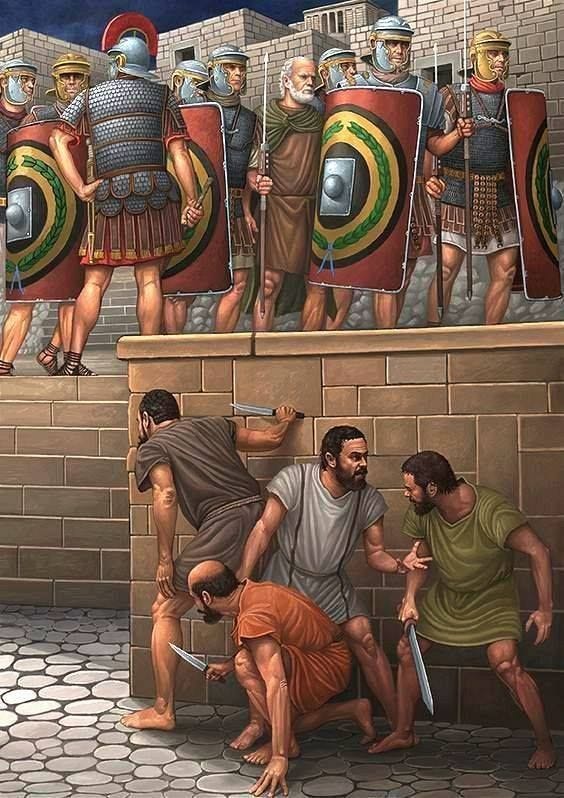
They told Jesus and spilled all the tea:
“There were present at that season some that told him of the Galilaeans, whose blood Pilate had mingled with their sacrifices.”–Luke 13:1
Jesus spent a lot of time in Galilee and understood the conditions there; the movements, the zeal, the conspiratorial airs. So He warns them, “Suppose ye that these Galilaeans were sinners above all the Galilaeans, because they suffered such things? I tell you, Nay: but, except ye repent, ye shall all likewise perish.”
I wonder what Simon Zealots was thinking.
Simon Zelotes is the only disciple identified with a specific religious political movement, the Zealots. Though we know nothing about him personally except his name, his affiliation tells us a great deal.
The “Galilaens” were a group of Jewish nationalist who were concerned about the spiritual purity of the nation and looking for any opportunity to overthrow the Romans. They’d become infamous for their “zeal” and willingness to suffer and die for their cause.
The Jews hated the Roman and bristled under their yokes of oppression. The Zealots were mostly priests and had chosen their name to associate themselves with Old Testament figures like Phinehas.
So what is a Zealot doing among the disciples of Jesus?
Simon recognized Jesus as the Messiah but, just like all the other disciples, misunderstood His mission. They wanted a Savior from the Romans not from sin.
This belief was fervently held by the Zealots and other nationalist groups. So when Jesus warned His disciples that He would suffer, bleed, and die, none of his disciples understood what He meant. There was a stark divergence between the Zealot messiah and Jesus the Messiah, between an earthly kingdom and the kingdom “not of this world.”
So Simon would have to choose.
Jesus talked constantly about loving your enemies, blessing them that curse you and spitefully take advantage of you. That’s an unmistakable command to love the Romans.
Jonah had a similar choice.
The Assyrians were wicked and cruel. Israel suffered under their yoke and Jonah wanted to see them punished. He wanted retribution not mercy. But God sent him to offer the Ninevites a chance to repent and be saved.
Jonah would rather die than see them saved.
He went down and down until he finally made a bargain with death, instructing the sailors to throw him overboard into the turbulent sea. But the prophet “mad about salvation” was saved by a fish. But so strong was his hatred and prejudice, so powerful his nationalism, that it took Jonah three whole days and nights before he prayed to be delivered.
Jonah was in a lost condition. And in order to save him God put Jonah in a position which reflected His true condition; trapped in the belly of a beast he could not control. Hatred and rebellion is like that; they can swallow us up and we no longer have control over where we go and how we live.
Sin keeps us longer than we planned to stay and takes us further than we thought we’d ever go.
Governments and churches eager to replace the Holy Spirit with state power are an abomination to God. Churches striving for political influence to advance their doctrines are admitting without confession that they have failed in their gospel mission and have abandoned the Rock to build on sinking sand.
Which would Simon the Zealot chose?
His path led to that platform where Pilate presented Jesus and Barabbas; the Son of God and the son of the Pharisee’s father. Most of his life had been dedicated to establishing a Jewish nation. His disappointment in Jesus allowing Himself to be taken and abused prompted him to run.
But now, whether literally in the crowd or figuratively, the Zealot would have to choose which kingdom he would join. This was a confusing position which reflected the confused condition of his life.
Jesus or Barabbas.
There could be no alliance between the Zealots and the followers of Jesus. There was no harmony or cooperation between the messiahs. It was either/or.
The Bible testimony says that Simon chose wisely,
“And when they were come in, they went up into an upper room, where abode both Peter, and James, and John, and Andrew, Philip, and Thomas, Bartholomew, and Matthew, James the son of Alphaeus, and Simon Zelotes, and Judas the brother of James.”
His path winded through the depths of disappointment and confusion to a decision to abandon his cherished beliefs and embrace the precious Savior come to save people from sin. Religious nationalism can hold us captive to a comfortable but utterly false idea of God. What seems like innocent patriotism is really something else.
Jesus never combined church and state, never endorsed a Christian state, never used force to make anyone obey.
God is no respecter of persons and all are invited to sit at His welcome table. There is no exclusion based on race or national origin in the kingdom of God. Divinity does not require state power to advance God’s will.
Simon was in the Upper Room receiving the Holy Spirit only because he let the knives go, let the national resentments go, let the sectarian machinations, go. And he embraced true peace and true power instead. When Jerusalem was destroyed in A.D. 70 Simon was not among the Zealots who perished in the temple fighting the Romans.
The choice was Pella or Jerusalem; Simon and all other Christians chose Pella rather than revolt and rebellion in Jerusalem; the kingdom of God over the kingdoms of this world. Simon’s path led him to life.
Where are you going?